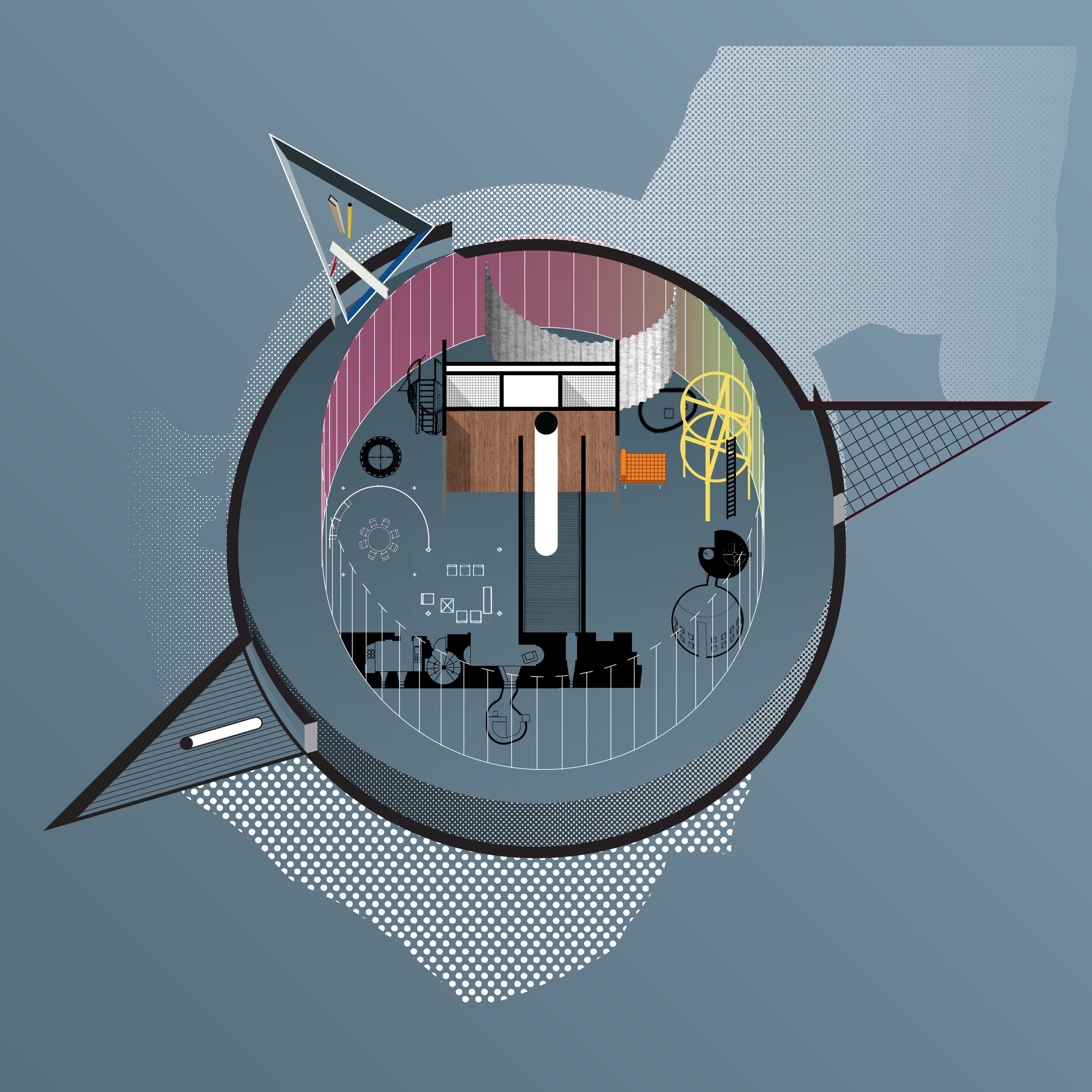
This is a house whose arrangement is based on the first known map of the world, the Babylonian Imago Mundi dated to roughly the 6th century BC. Inscribed into a clay tablet is an idea of the known world — both the things in it and the knowledge to describe it. The act of map making is an act of architectural production — a way of making a world.
The house is composed of references to many other houses: Mies van der Rohe, Zaha Hadid, and castles by way of Louis Kahn. Its exterior walls define the boundary of a world; its interior unfolds as a series of territories.
Domestic space has become, for many of us, the limit of our world. Work, school, the gym, the pub, all those dispersed activities now compressed in an undifferentiated smear across the domestic landscape with very little relation to the usual spatial decorum of home.
With boundary walls as our horizons, domestic interiors have become vast landscapes however tiny their reality. Just as maps shrink vast geographies — even whole planets — to things you can hold in your hand.
The House That Is The Whole World blurs the distinction between inside and outside, between everywhere and here, between the vast and the intimate, between the whole wide world and the home.
A house designed under quarantine for the AA’s Earth Gallery show. A house for when the whole world is at home, and home is the whole world.