
Empire of Ice Cream
Drawings · Since 2011
An ongoing series of felt-tip drawings on graph paper, begun in 2011 for San Rocco’s The Even Covering of the Field. Fragments of plans accumulate into imagined territories: temples, football pitches, corridors, orchards and half-remembered buildings. The drawings were exhibited at Betts Project in January 2019. Catalogue texts by Nicola Barker and Pier Paolo Tamburelli follow the drawings.
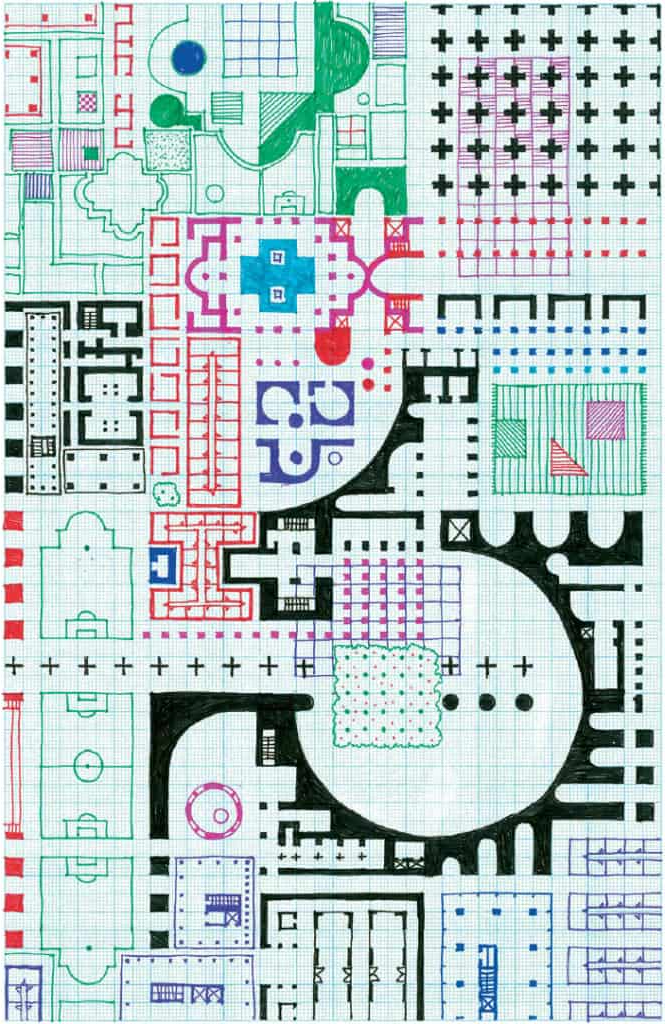
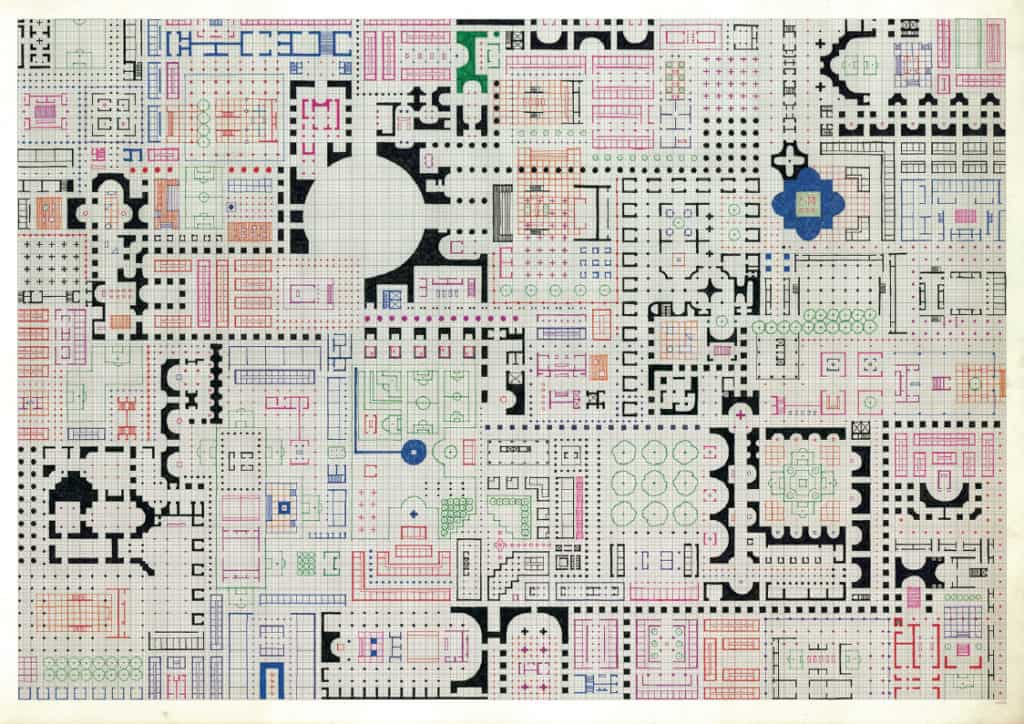
Fragments of a world
Grand monuments meet generic everyday spaces. A piece of Parliament, a church or a record cover can enter the same field, without settling into a single architectural order.
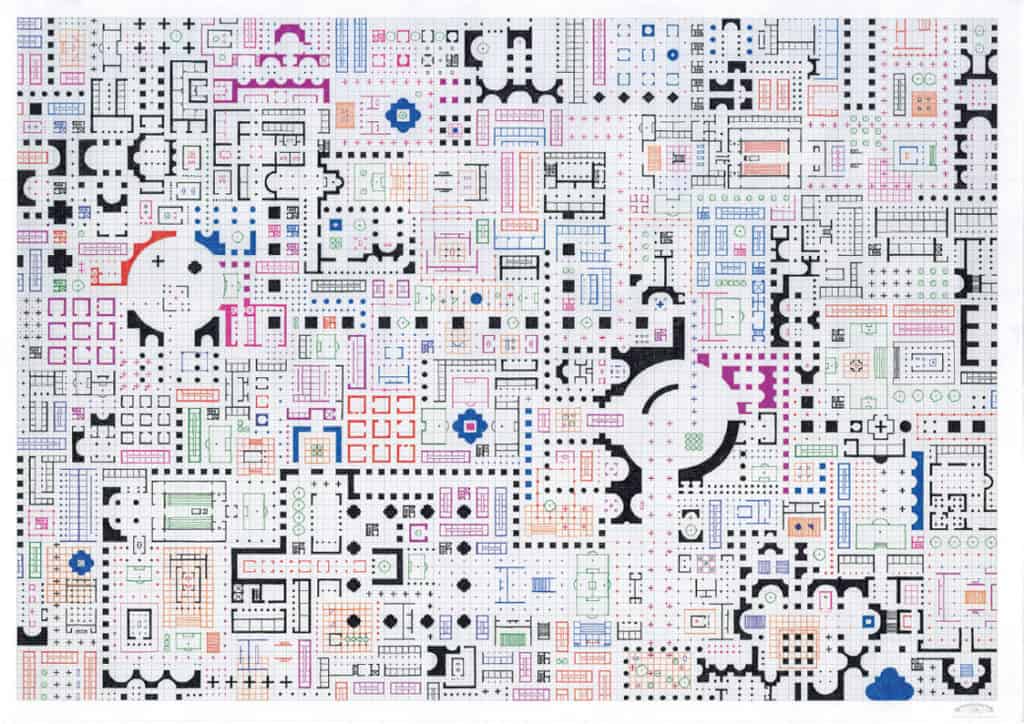
Plans that will never be built
The drawings grow according to their own patterns and associations. They explore architectural ideas through graphic form, in a tradition including Piranesi’s Campo Marzio and Archizoom’s No-Stop City.
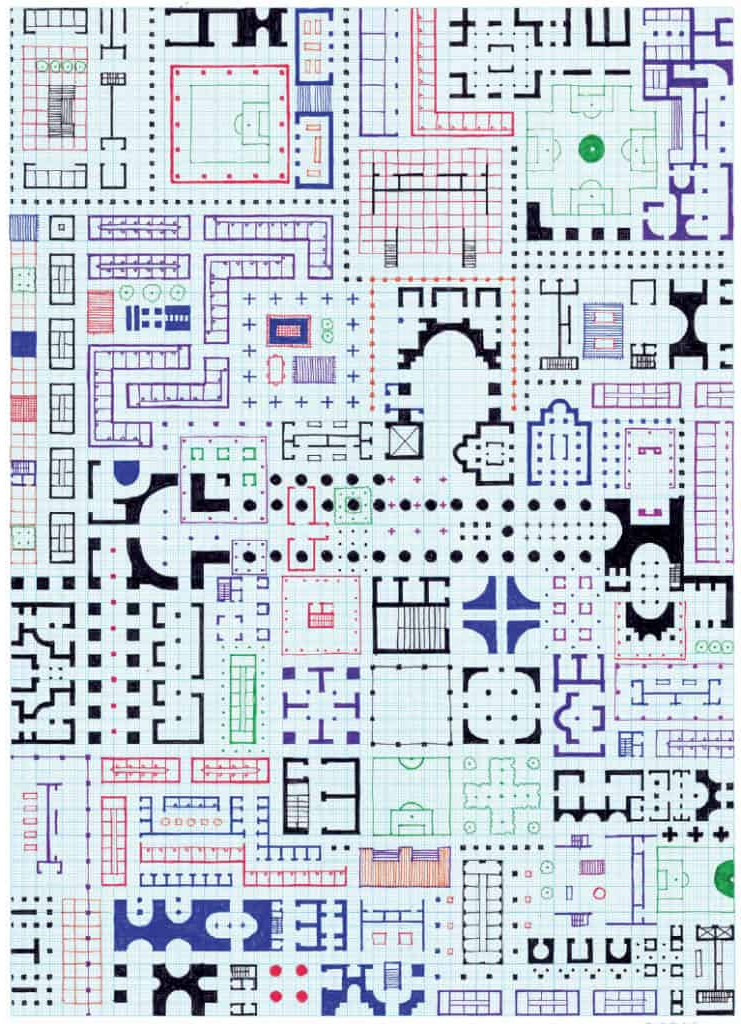
The even covering of the field
The project began with an invitation from San Rocco magazine. The page becomes a territory where fragments spread to the limits of the graph paper.
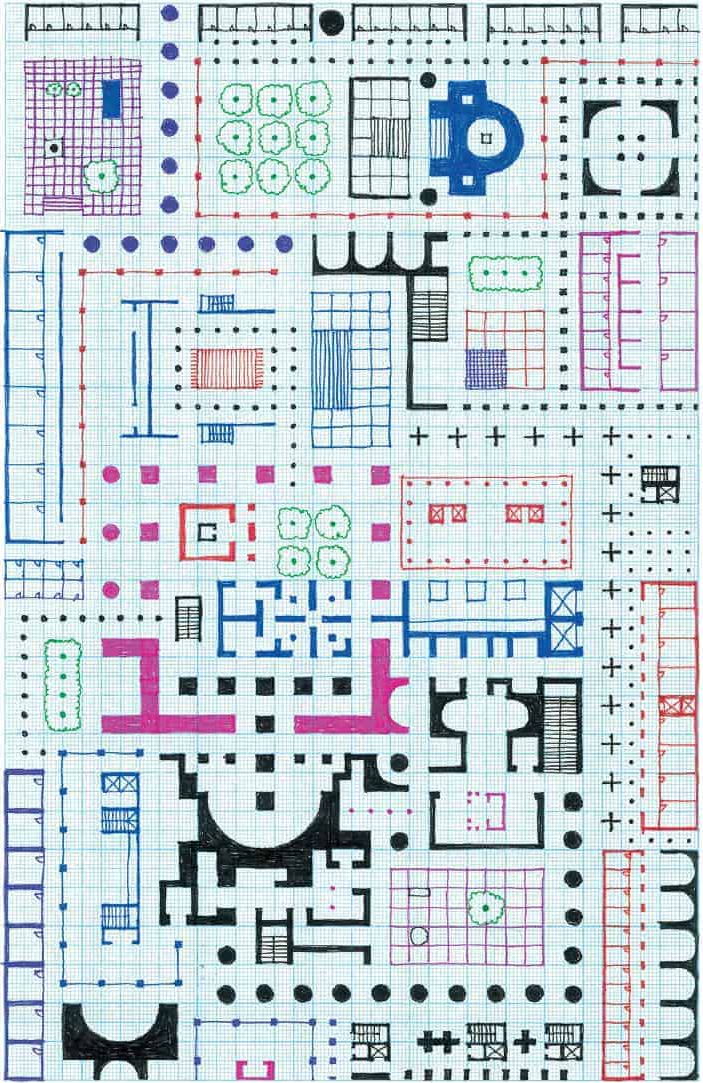
Architectural memory
Felt-tip lines trace enclaves, borders and passageways. Individual forms dissolve into neighbours, producing a field that stays coherent while its architectural language continually changes.
Nicola Barker
Empire of Ice Cream · Catalogue text, 2019
As a writer I find myself constantly trying to use language (which is often glued down, static, predicated on meaning) to try and transcend language. I do this full in the knowledge that, at some level, it is impossible to use the very thing that imprisons you to set you free.
But what other tools do I have?
As artists all we can really do is try to create interesting spaces - colourful little gaps - that somehow allow us to investigate what cannot be spoken, what may not be drawn, what will not be perfectly understood. And we do this in any way that we can; it’s an exquisite urge, a joyful, childish, promiscuous urge, often employing contradiction and jokes and play and paradox: finding sound through silence and silence through sound, finding space through confinement and confinement in space, finding truth through falsehood and falsehood in truth.
Kali worshippers sometimes talk about the ‘Pair of Opposites.’ The Hindu Goddess Kali embodies contradiction - she is the creator and the destroyer. In the west we find this idea worrying (at best). We become anxious that it contains within its seed an element of (Heaven forbid) hypocrisy. The Hindus are wiser. They know that (for example) fire both sustains life and eradicates it. It can be everything all at once.
Serious mischief-makers - like Sam Jacob - are nothing more (and nothing less) than tenacious embryos pummelling away with their persistent elbows at the enveloping flesh of the womb of meaning.
Creativity is a gradual inching forward (sometimes a gradual inching back). It’s a series of apparently inconsequential marks, a quick blink, a double take, an itch, a sneeze…
These are our tiny weapons. We fight monumental wars with them.
un-Piranesi
Pier Paolo Tamburelli
The drawings of Empire of Ice Cream seem architectural. They are made on squared paper and look like plans. And yet without scale or site, calling them plans might be rather misleading. We can see stairs, door and windows, pillars and walls but it is never really possible to single out a building. Neither is it possible to work out what is inside or outside. There is abundance of black poché that creates an atmosphere of architecture. But there is a lot of pink and purple too.
Empire of Ice Cream explicitly refers to a disciplinary tradition. But once again this association is misleading. At first sight, Empire of Ice Cream looks like a mix of Piranesi’s Campo Marzio and Archizoom’s No-Stop City. Like the Campo Marzio, these drawings show infinite variations of architectural motifs. And like No-Stop City they seem to extend indefinitely in space.
But these drawings are very different from their apparent precedents. While the Campo Marzio was the final output of Piranesi’s obsession with disciplinary accuracy (precisely distinguishing archaeological evidence from pure invention). And while No-Stop City wanted to didactically expose the essence of the capitalistic city, Empire of Ice Cream is far less defined in ideological terms.
Sam Jacob’s drawings are deliberately loose and generic. No precise quote can be detected. Something looks Roman, something Miesian, but it’s hard to spot a precise source: No Temple of Venus and Roma, no Tugendhat.
In other words, these drawings don’t come from ‘within’ architecture, they coming from somewhere outside it. Unlike Piranesi, this isn’t somebody trying to escape architecture by producing even more absurd images of architecture, but someone approaching architecture from the outside with a mannered naivety. There is no fear of architecture, but a strange love. Love for architecture in a world without architecture.
These are not the drawings of an architect. So who is the author of Empire of Ice Cream? Who made these drawings? Yes, Sam Jacob, but Sam Jacob as …what?
Did he uncovered Empire of Ice Cream by rubbing a pencil over the blank sheet on top of a pad of paper like the Dude in one of the best scenes of “Big Lebowsky”? Is Empire of Ice Cream the amusement of an unnecessarily erudite kid (maybe one of those sons of Silicon Valley billionaires who are only allowed to play with Steinerschule wooden toys)? Is Empire of Ice Cream the evidence of a conspiracy to conquer the world?
Whoever the author is, Empire of Ice Cream extends indefinitely, but this infinite extension is time-bound, not space-bound. The infinity of Is Empire of Ice Cream is not space but time: The infinity of business meetings, of boring afternoons in the countryside, of the time it takes to cover a A1 page by drawing.
Empire of Ice Cream uses time to narrate architecture as if it were a story. These are traces of affection (or, maybe, hatred). The architectural signs left on the paper are – more than instructions for something to be built – traces of desires, proofs of moments of existence. Empire of Ice Cream proves that the (fictive) person who left these signs was (fictively) alive.
Empire of Ice Cream is a post-post-modern product. All the plans assimilated into these drawings are already translated into post-modern jargon: A post-modern version of Villa Adriana, next to a post-modern version of Versailles, next to a post-modern version of Hadid, next to a post-modern version of Stanley Tigerman. All the formal freedom of the last 30 years appears here for what it finally is: Indifference.
For all its commitment to communication and linguistics, here post-modernism appears here as a form of linguistic exhaustion. A terminal, all-encompassing white noise. Yet this great annihilation strangely opens up a space for a new directness. Empire of Ice Cream longs for an architecture that is just plain and human.
Empire of Ice Cream belongs to a city whose structure is no longer No-Stop City’s repetitive-but-somehow-honest “and the same, and the same, and the same, …”. It belongs to a post-capitalistic (or whatever you want to call it) city that says something more like “and whatever, and whatever, and whatever, …”
Empire of Ice Cream is a consciously post-Thatcherite London creature. While the limits of this kind of city are evident the drawings also show that, somehow, it is possible to survive in this world. Even that post-Thatcherite London can, at times, be sweet and be fun.
For exhibitions, acquisitions and commissions: [email protected].